
March 2026:
In which I tell you about a memory that's been haunting me lately.

Hi lovely,
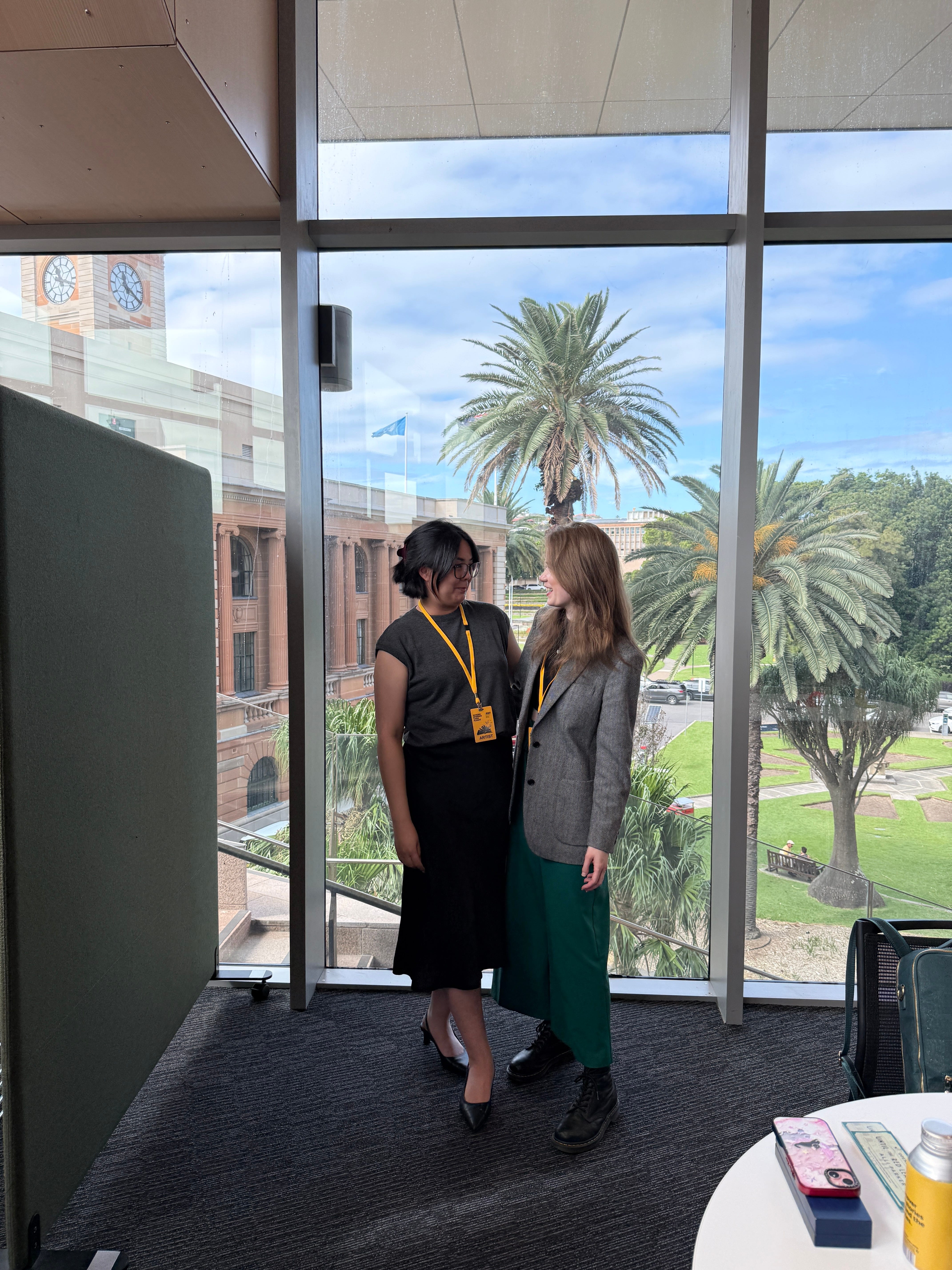
It’s been a minute since I last wrote a newsletter. March was an intensely busy month and I’m really only now coming up for air. I had the distinct pleasure of attending the Newcastle Writers’ Festival last month, which was up there with one of my favourite writers’ festivals ever. It’s a small team, but punches well above its weight.
I was on two panels over the weekend: one with a good friend of mine, Emma Pei-Yin, author of When Sleeping Women Wake, and moderated by Phoebe McIlwriath, talking about identity. Emma’s book is inspired by her grandparents’ story of surviving in Japanese Occupied Hong Kong and becoming a part of the East River Resistance. We often joke that our ancestors would be furious to know we’re friends.
Honestly, I’m just glad the world has changed enough that we can be.
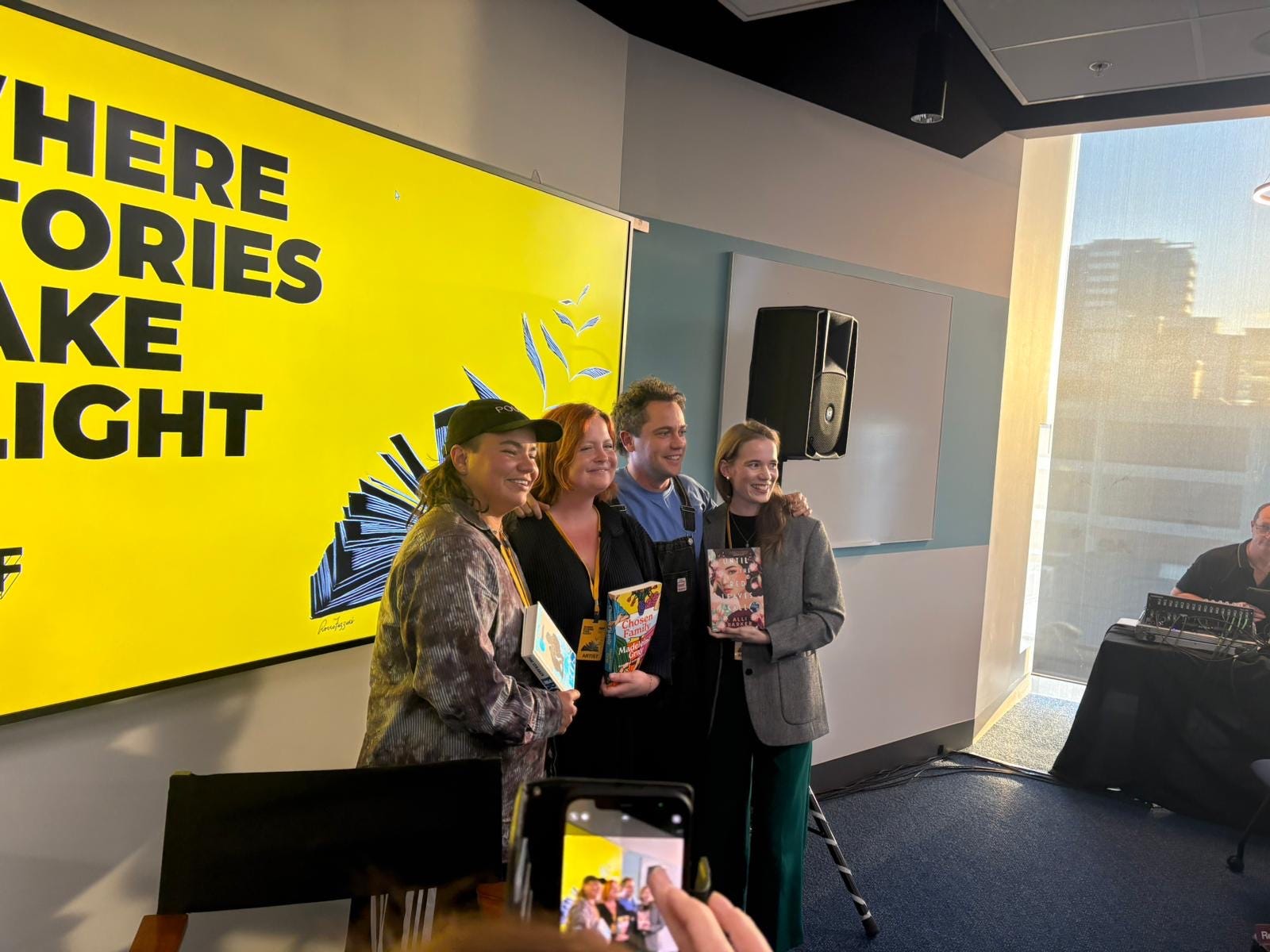
My second panel was with Madeleine Grey (Green Dot & Chosen Family) and Zoe Terakes (Eros), moderated by Kaya Wilson, chatting about writing queer literature. Between the three of us, we presented a spectrum of different ways queer stories are being told right now and, again, I’m grateful that we can deepen our representation on this front too.
These stories more important now than ever - and they’ve always been important.
I’m also working on something new. I don’t want to say too much about it yet (I’ve jinxed myself with that before), but the process of developing the idea has got me thinking about something that happened to me five years ago.
It’s something that makes me feel uncomfortable when I muse on it but I do think it’s important to share the things that make us uncomfortable. The more we talk about these type of things, the more people can understand why they’re harmful or painful.
Allow me to set the scene:
It’s January 2021. I’m trying to regain some semblance of normality after several Covid lockdowns. I’ve just started working seriously on this manuscript called At the Foot of the Cherry Tree, trying to work out the best way to tell my grandparents’ love story.
I’ve also recently moved into a new place, which has a small second bedroom I’m planning to use as a dedicated study to write in.
I want some artwork to hang on the wall, so I do what anyone does in this scenario.
I go on Facebook Marketplace.
I’m writing about my grandmother, so I’m looking for something Japanese. Half the things on Facebook Marketplace that are labelled Japanese are not.
I’m not wholly surprised by this.
But then I see something that is Japanese and is stunning.
It’s a lacquer painting of two women in front of an autumnal maple tree.
Simple. Gorgeous.
And it’s $10.
There’s only one photo and it’s quite a wide shot from a distance. But for $10, it’s not much of a risk.
I contact the seller and ask if it’s still available.
They respond immediately and tell me it is.
Now, I know that with lacquer paintings, they aren’t always designed to be hung. But this is listed as a painting. I ask the seller if they can send over a few photos of the detail of the women and of the back.
They send a bunch over but I can’t make out the back clearly. There don’t seem to be any hooks and I can’t see a wire to hang it up either. So I ask if there are any.
The seller responds and explains the item is a thin, hollow enclosed box. Not unusual for a lacquer painting.
Then the seller says, ‘Do you collect this sort of item?’
This seems like an odd thing for them to ask. I reply ‘No, I have just moved into a new place and was thinking about hanging it on my wall.’
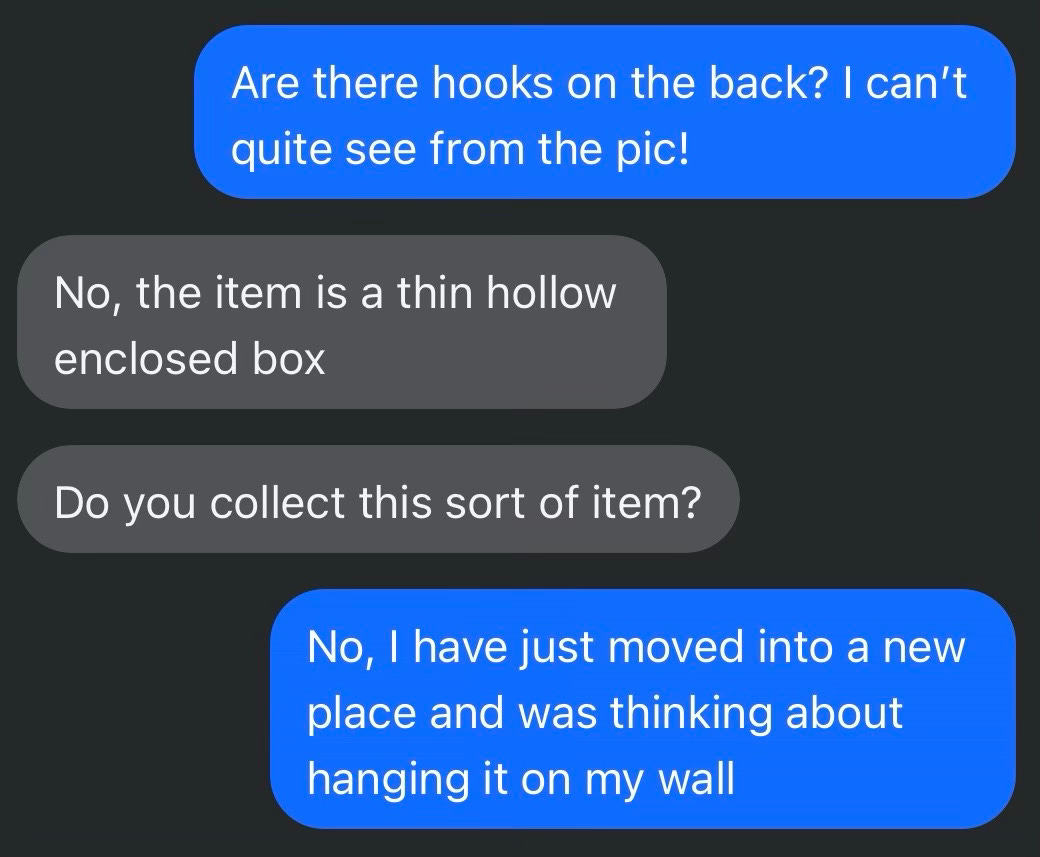
All conversation thus far was fairly rapid. Here, it grinds to a halt. I get nothing for thirty minutes, until I get a notification from Facebook that informs me the piece is now marked as ‘Pending.’
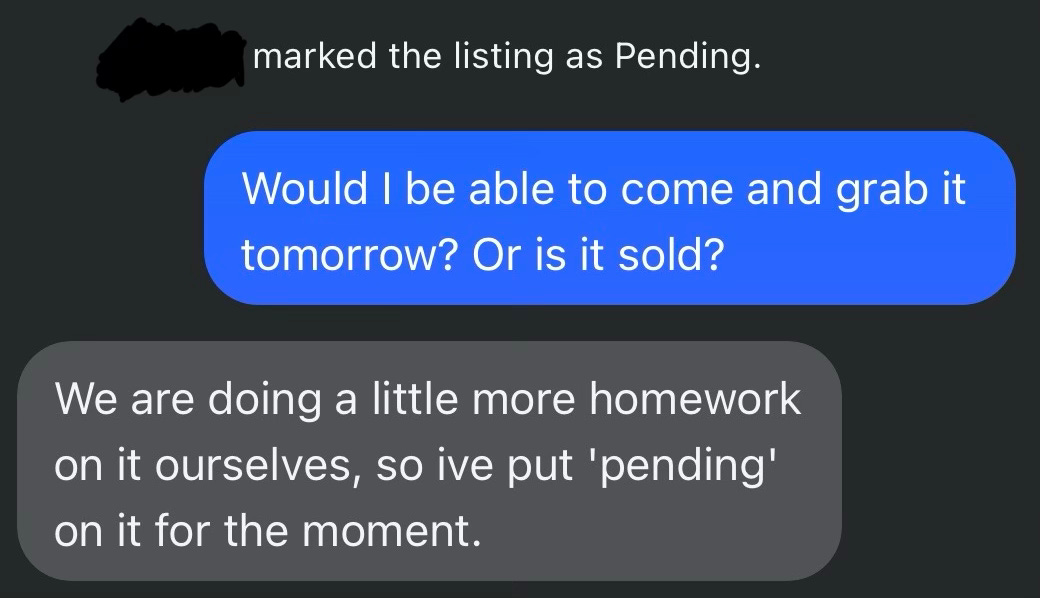
I’m confused. I send a message asking if I can pick it up tomorrow or if it’s already sold.
Now, there’s one other piece of context you need for this next part to make sense.
On the anniversary of Hiroshima in 2020, I posted a thread on Twitter, detailing my grandmother’s story of survival. It got quite a lot of attention and prompted a lot of conversation. I posted a collated version of the tweets on my Facebook profile so my family could see it and share it too. For that to happen, I had to have it public on my profile.
It was pretty much the only thing you could see on my profile if you weren’t my friend on Facebook.
So, I message them and ask if the piece is still for sale or not, now that it doesn’t seem to be available anymore.
Their response? ‘We are doing a little more homework ourselves, so I’ve put “pending” on it for the moment.’
Then, ten minutes later, when I don’t immediately reply: ‘I see you have a connection with Japan?’
It’s when I receive this message that I realise what is going on here.
They’ve thought my questions are a little odd - even though they’ve literally listed it as a painting and asking to see the back isn’t that strange. So they’ve snooped on my profile. Seen the story about my grandmother, realised that I’m Japanese…
…and have decided their $10 lacquer painting could be worth way more, because why else would someone like me want it?
I reply to their not-quite-a-question statement: ‘Yes, my grandmother is Japanese. I was supposed to go there again last year but never went. Your piece reminds me of her.’
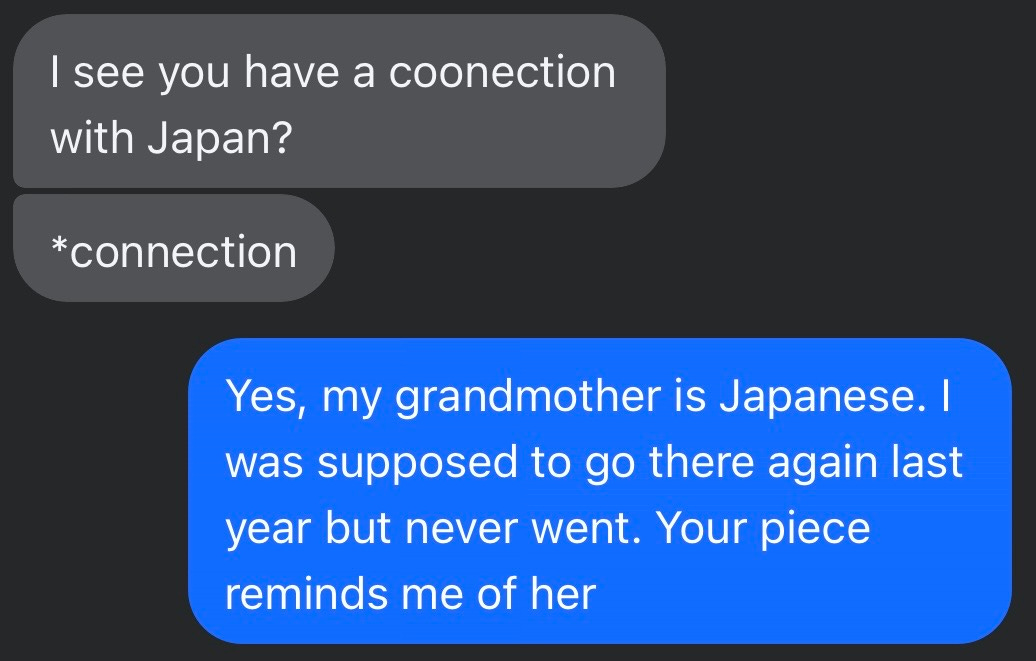
Somehow this incriminates me more in their eyes: ‘Can you tell me anything about Japanese lacquer please? This piece is a mystery.’
They’ve got Antiques Roadshow dollar signs in their eyes. They’ve picked up a random box somewhere or inherited it from a now-dead relative, wanted to offload it, but now they’ve got some secret Asian treasure.
I hate this. I absolutely hate everything about this scenario. This, my friends, is what’s called casual racism. It’s insidious. It’s disgusting. And it’s something millions of people living around the world have to deal with on a daily basis.
The thing that suddenly gives the seller’s item value is the attention of someone Japanese, someone who knows the culture, a secret collector who must know the value of this piece and are trying to get it for dirt cheap. I’m the dodgy one, trying to pull the wool over their eyes.
Tell me that’s not a stereotype of the Japanese.
I stay diplomatic and reply: ‘I’m sorry, I don’t know anything about Japanese lacquer. I just thought it was a pretty painting.’
And, my friends, in case you wanted to give this person the benefit of the doubt, in case you thought she was genuinely curious because it’s easy to pretend a racist doesn’t know what they’re doing, what they said next is what really sealed it for me.
Their response to me saying the truth - that I don’t know anything about Japanese lacquer - was this:
‘lol’
I kid you not.
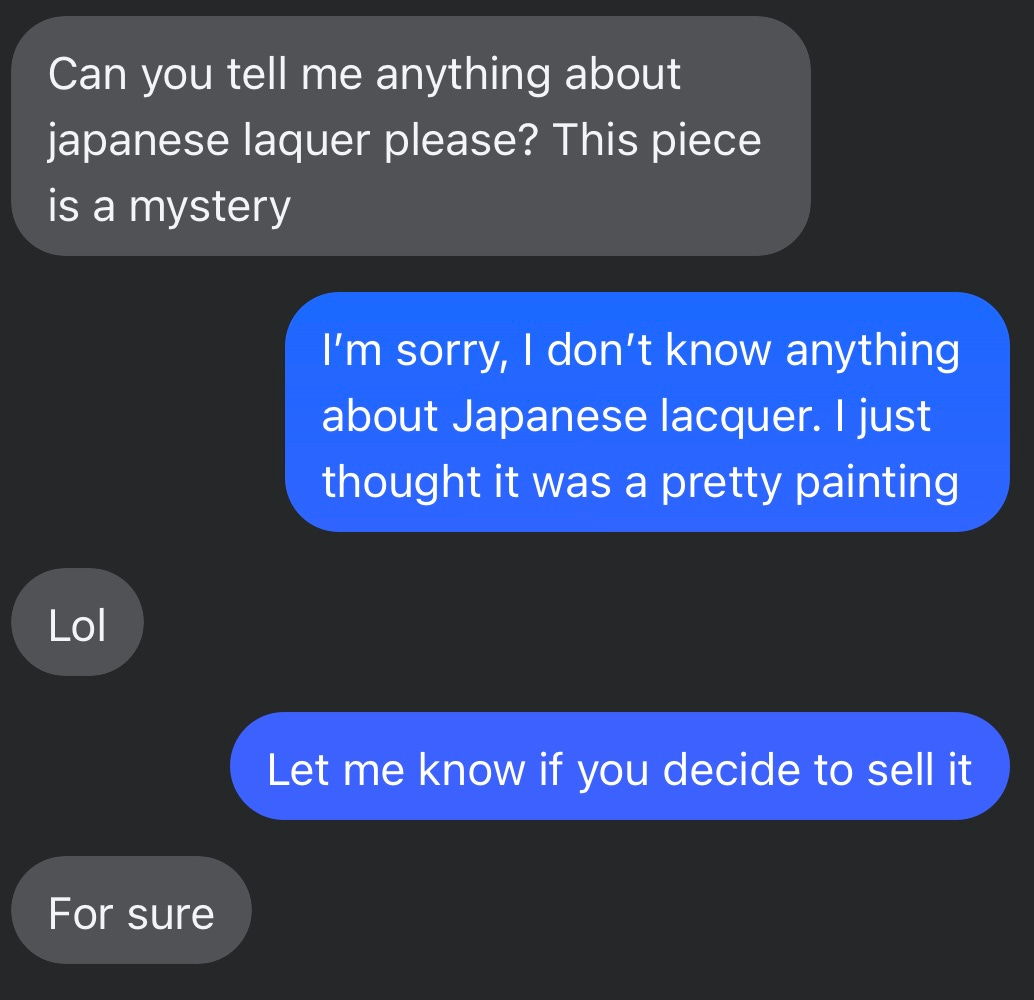
By now, I know I’m not getting this piece for $10.
I tell them to let me know if they decide to sell it.
They say they will.
A few days later, they take off the pending label.
And jack the price up.
Then they have the audacity to ask if I was still interested.
I ignore them at first but they ask again, so I tell them I’ll pass on the sale.
They sell it to someone else at their higher price.
This memory has been haunting me a lot of late. I don’t even really know why I’ve put this in a newsletter. I’m supposed to come up with a neat ending, a way to resolve this, but this happened over five years ago and still sits uncomfortably in my chest when I think about it.
This is far from the most racist thing anyone’s ever said to me (or the wildest racist thing, but I’ll probably never write that down in a newsletter) and, in terms of micro-aggressions, this is pretty mild. There are people out there every day being racially vilified simply for existing, for being born in a different part of the world to someone else. Cities are being bombed for the reason that someone wants control. People are dying every day because they’re different. They are other.
We aren’t other. No one is other. We are all simply human.
But, honestly, more fool me on this one. Because I ignored the biggest red flag on the listing from the start.
The title.
They’d listed it as ‘Oriental Lacquered Painting’.
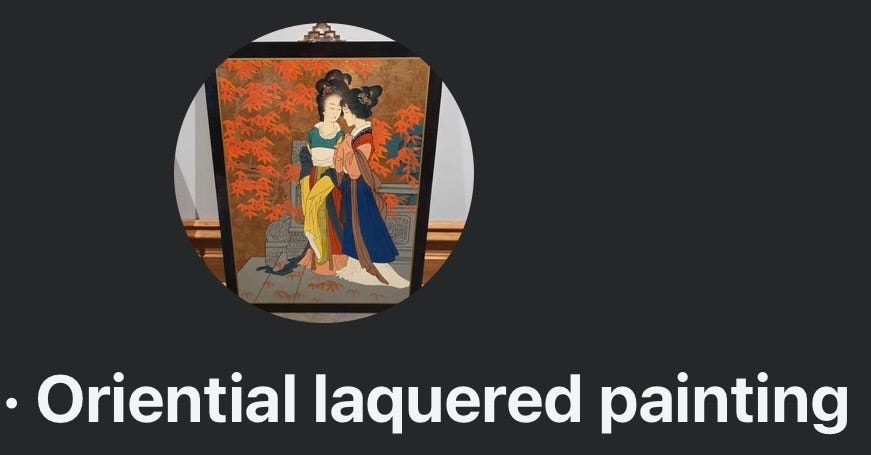
I really should’ve known better.
Things I’ve been reading lately:
The Cursed Road by Laura McCluskey. I loved The Wolf Tree, the first book in this Scottish thriller series by Aussie author, McCluskey. It was so tense and atmospheric, I actually felt cold reading it. The Cursed Road is an incredible follow up. We rejoin George and Richie almost a year after the end of the first book, where the ramifications of those events are still being heavily felt. But when a cold case Richie’s never been able to solve turns up with new evidence, the two of them are thrust back together to head into the Scottish Highlands to find the truth. It’s a big call, but I think I actually loved The Cursed Road more? Definitely worth a read if you love a procedural thriller.
Guts by Melissa Leong. I’m a Masterchef girlie and when Mel joined as a judge with Jock Zonfrillo and Andy Allen, I was really keen to see what she’d bring to the show. Turns out: loads. I loved watching her bring her own perspective on food, a perspective that contrasted greatly with the more European schools of thought in the judges. Leong’s memoir is gorgeous. She is, unsurprisingly, an amazing writer, and I was fascinated to learn about how she built her career to what it is today and she’s included some of her favourite recipes after each section. If you love foodie memoirs, you absolutely have to check this out.
Hope all is well in your world. If you need a pick me up, watch this video of the Artemis II astronauts asking if they can name a new crater of the moon after one of the astronaut’s late wife who died of breast cancer.
It makes me bawl every time I see it and reminds me that empathy and connection are two of the most powerful things we have as humans.
Until next time,
Alli x